


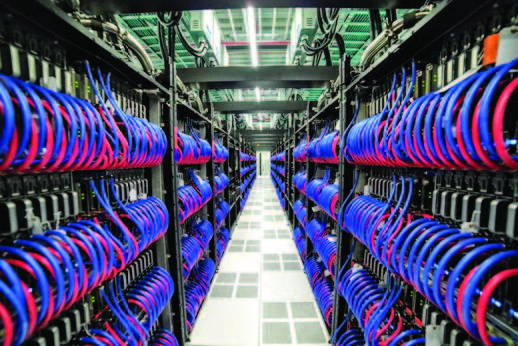
Inside the Frontier supercomputer, a network of tubes carries water to cool thousands of computer chips in the system.
Photo Source: Oak Ridge National Laboratory/Hewlett Packard Enterprise
Around 2010, numerous countries initiated a competition to develop a supercomputer capable of
surpassing the ExaFLOPS (1018 floating-point operations per second) threshold, a formidable objective. In May 2022, Frontier, a supercomputer engineered by a collaboration between Cray-HPE and the Oak Ridge National Laboratory, successfully achieved this milestone. With a speed of 1.102 ExaFLOPS recorded during the HPLinpack benchmark program, it secured its title as the world’s fastest supercomputer. V. Rajaraman recently authored an article (Reson 2023, 28, 567–576), where he recounts the events leading to the conception of Frontier and elucidates its architectural framework. Additionally, Rajaraman outlines various benchmarks employed to assess the performance of high-performance computing systems.
At the heart of Frontier’s unprecedented computational power lies a meticulously crafted architectural framework, designed to optimize performance, efficiency, and scalability. Frontier adopts a heterogeneous computing architecture, integrating a blend of central processing units (CPUs) and graphics processing units (GPUs) in a symbiotic relationship. The integration of AMD’s latest Zen CPU architecture and Radeon Instinct GPU accelerators forms the backbone of Frontier’s computational prowess. This hybrid design harnesses the parallel processing capabilities of GPUs, coupled with the versatility of CPUs, to tackle a diverse array of workloads with unmatched efficiency and speed.
Frontier comprises 74 HPE Cray EX supercomputer cabinets, specifically designed to facilitate next-generation supercomputing performance and scalability, which are now available for early science access. Within each node, there is one tailored EPYC™ processor and four AMD Instinct™ accelerators, totaling over 9,400 CPUs and more than 37,000 GPUs across the entire system. This configuration offers developers enhanced programming capabilities for their applications, thanks to the coherency facilitated by the EPYC processors and instinct accelerators.
Moreover, Frontier boasts a state-of-the-art interconnect network, facilitating seamless communication and data exchange across its expansive architecture. This high-speed, low-latency network enables researchers to leverage Frontier’s immense computational resources to simulate complex phenomena, analyze vast datasets, and unravel the mysteries of the universe with unparalleled precision.
Frontier stands as a testament to the indomitable human spirit and the boundless potential of technology to shape a better future for all. As scientists harness its capabilities to unlock the mysteries of the universe and address global challenges, Frontier epitomizes the relentless pursuit of knowledge and the transformative power of innovation in the quest for a brighter tomorrow.
– Suyog Poudel
Ankuram Academy (2023)


