


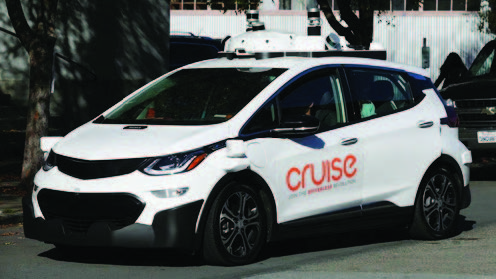
A self-driving GM Bolt EV is seen during a media event where Cruise, GM’s autonomous car unit, showed off its self-driving cars in San Francisco, California.
Photo Source: Elijah Nouvelage/Reuters
Autonomous self-driving vehicles represent a pinnacle of technological innovation, promising to transform the landscape of transportation as we know it. This revolution didn’t happen overnight; it’s the culmination of decades of research, development, and ingenuity. Understanding the history, working mechanisms, and future prospects of autonomous vehicles unveils a narrative of human ambition and technological progress.
While the idea of self-driving vehicles traces back to science fiction, the practical pursuit of autonomous transportation gained momentum in the late 20th century. One of the pioneers in this field was Ernst Dickmanns, a German engineer who, in the 1980s, transformed a Mercedes-Benz van into an autonomous vehicle equipped with an integrated computer. Dickmanns’ work laid crucial foundations, showcasing the potential of autonomous systems to navigate real-world environments.
At the heart of autonomous self-driving vehicles lies a complex fusion of hardware and software technologies. Autonomous self-driving vehicles rely on an array of sensors, including radar, cameras, ultrasonic sensors, and LiDAR, to perceive and interpret their surroundings in real-time. Advanced algorithms process this sensory data, enabling the vehicle to make split-second decisions, navigate through traffic, and respond to dynamic road conditions. Machine learning and artificial intelligence play pivotal roles, allowing autonomous vehicles to continually improve their driving capabilities through experience and data analysis.
LiDAR, in particular, plays a crucial role in providing detailed 3D mapping of the vehicle’s environment. By emitting laser pulses and measuring the time it takes for them to return after bouncing off objects, LiDAR sensors create high-resolution maps that enable precise localization and object detection. One key technology driving the advancement of autonomous vehicles is machine learning. Through continuous exposure to different driving scenarios, AI algorithms improve their decision-making abilities, learning to adapt to diverse road conditions and unexpected situations.
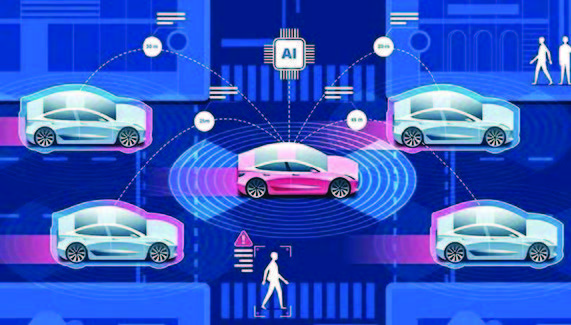
Working of LiDAR Sensor in Autonomous Vehicles.
Photos Source: https://medium.com/cogitotech by Matthew-Mcmullen
AI algorithms process vast amounts of sensor data, including information from cameras, radar, LiDAR, and ultrasonic sensors, to create a comprehensive understanding of the vehicle’s surroundings. Machine learning techniques allow the vehicle to learn from its experiences and improve its driving capabilities over time. By analyzing patterns in data, AI-powered systems can anticipate and respond to various traffic scenarios, navigate complex roadways, and make split-second decisions to ensure safety and efficiency.
The rise of autonomous self-driving vehicles represents a paradigm shift in transportation, reshaping the way we move and interact with our environment. With continued innovation and collaboration, the future of autonomous mobility holds the promise of a safer, more efficient, and sustainable transportation ecosystem for generations to come.
-Kushal Poudel
Ankuram Academy (2020)
B-Tech, India (2023)


