


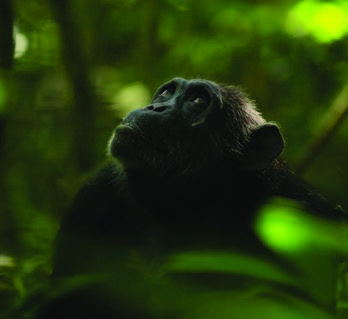
Leonora, a 46-year-old female in the Ngogo community of chimpanzees in Kibale National Park in Uganda. She last gave birth at age 34.
Photo Source: Kevin Langergraber/Arizona State University
Menopause, which occurs in humans and a few other mammal species like certain toothed whales, has also been observed in chimpanzees. Wood et al., published a study in Science (Science 2023, 382, eadd5473). detailing their findings on menopause onset in a community of wild chimpanzees in Uganda’s Kibale National Park. They noted menopause typically starts around age 50 in chimpanzees, with fertility declining from around age 30.
Drawing from two decades of observations, Wood and co-workers gathered demographic and hormonal information regarding female members of the chimpanzee community. They analyzed the mortality and fertility patterns of 185 chimpanzees and discovered that, on average, females spent approximately one-fifth of their lives in a phase beyond reproduction.
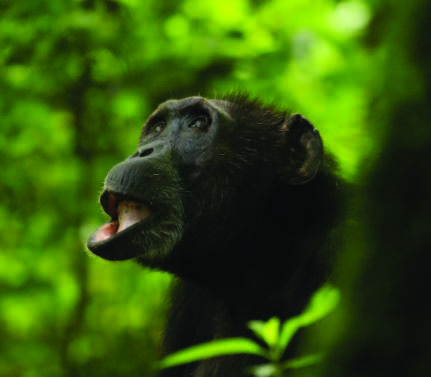
Garbo, a post-reproductive female of the Ngogo community of chimpanzees in Kibale National Park, Uganda.
Photo Source: Kevin Langergraber/Arizona State University
They also studied urine samples collected from 66 female chimps at different reproductive stages, often gathered from leaves or plastic sheets. They found that older female chimps undergo hormonal changes, similar to menopausal shifts seen in human females, starting around age 30 and tapering off around age 50.

Ma Rainey died in 2012 at age 63. She had her last known pregnancy 15 years earlier, at age 48.
Photo Source: Kevin Langergraber/Arizona State University
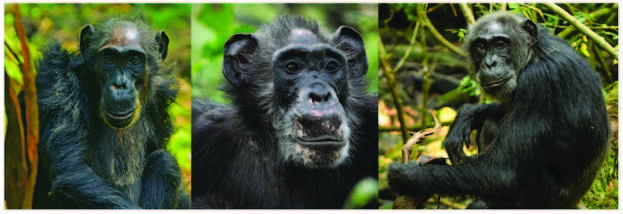
Three post-reproductive female chimpanzees. From left to right are MARL (died at age 69), MAR (died at 64), and Sutherland (still living at age 61).
Photo Source: Wood et al., Science 2023, 382, eadd5473
Langergraber, a co-worker of this research noted that the fertility patterns observed in Ngogo chimpanzees (chimpanzee community located in Uganda’s Kibale National Park) closely resemble those found in humans. He emphasized that the physiological mechanism driving reproductive cessation in chimpanzees is essentially the same as in humans.
In conclusion, the research conducted by Wood and colleagues reveals that menopause, a phenomenon previously observed in humans and select mammal species, also occurs in chimpanzees. This discovery, based on observations in Uganda’s Kibale National Park, highlights a similarity in reproductive patterns between humans and chimpanzees. Moreover, the hormonal changes observed in older female chimpanzees mirror those seen in menopausal human females, suggesting a shared underlying physiological mechanism. This not only expands our understanding of chimpanzee biology but also underscores the interconnectedness of evolutionary processes across species.
– Rajan Poudel
Co-Editor
Ankuram Academy (2023)


