


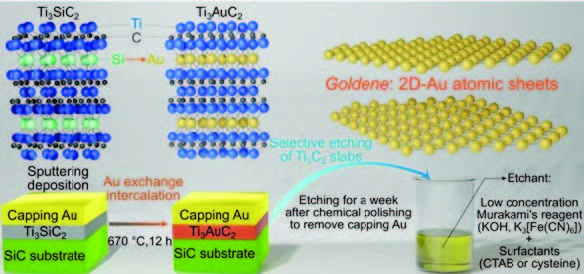
Schematic illustration of preparation of Goldene.
Photo Source: Hultman et.al., Nat. Synth 2024: https://doi.org/10.1038/s44160-024-00518-4
The search for two-dimensional materials possessing distinct characteristics has led to the identification of various compounds like graphene and phosphorene.
However, metals pose a unique challenge due to their inclination to form metallic bonds with themselves, resulting in the formation of nanoparticle clusters or multi-layered sheets. Previous endeavors have yielded either extremely thin sheets consisting of several atoms or monolayers sandwiched between or attached to other materials, making detachment unfeasible. Consequently, achieving a two-dimensional, single-atom thick sheet from metal blocks proves to be a formidable task.
In a groundbreaking study published in the prestigious journal Nature Synthesis (Nat. Synth 2024: https://doi.org/10.1038/s44160-024-00518-4), materials scientist Shun Kashiwaya and team successfully synthesized and analyzed Goldene, a two-dimensional material comprising a lone layer of gold atoms. Despite gold’s conventional classification as a metallic element, its two-dimensional structure demonstrates semiconductor properties, presenting innovative prospects for utilization in electronics, catalysis, photonics, sensing, and biomedicine.
Goldene monolayer sheets are synthesized by extracting titanium carbide (Ti3C2) layers from Ti3AuC2. Precise mixing of Murakami’s solution is crucial for the removal of titanium carbide. Additionally, the use of specific surfactants such as cetyltrimethylammonium bromide (CTAB) and cysteine is essential to prevent aggregation or curling of the sheets. The etching action of Murakami’s solution generates potassium ferrocyanide, which, when illuminated, liberates cyanide, facilitating the dissolution of gold. The entire process must occur in complete darkness.
In three-dimensional (3D) metals, electrons move freely, but in two-dimensional (2D) sheets, they’re confined, changing their behavior significantly. Superconductivity, where a material conducts electricity without resistance, usually requires extremely cold temperatures. Scientists anticipate that 2D metallic sheets could enable superconductivity at higher temperatures, making it more practical for real-world use. The
arrangement of electrons in a material determines its magnetic properties, so 2D metallic sheets might display novel magnetic behaviors due to unique electron interactions in this confined space. Additionally, the strong interactions and significant quantum effects in 2D metallic sheets could lead to entirely new phenomena not seen in conventional materials. These phenomena could revolutionize fields like quantum computing.
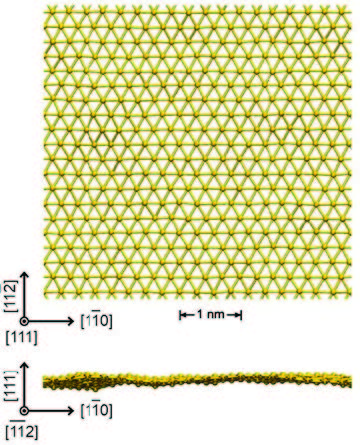
Plan and side orthographic views of a defect-free goldene monolayer. Supercell model used in AIMD simulations at 300 K. The crystallographic axes are relative to an Au(111) monolayer.
Photo Source: Hultman et.al., Nat. Synth 2024: https://doi.org/10.1038/s44160-024-00518-4
Goldene, a fresh addition to the realm of two-dimensional semiconductors, boasts enticing electronic attributes. As scientists delve deeper into its capabilities, Goldene stands on the brink of transforming various spheres of modern life, spanning electronics, environmental applications, and beyond. Upcoming investigations will delve into Goldene’s electronic and catalytic characteristics meticulously, aiming to unlock its potential for emerging technologies.
– Akrurmani Paudel
Ankuram Academy (2020)
BE, TU (2022)


