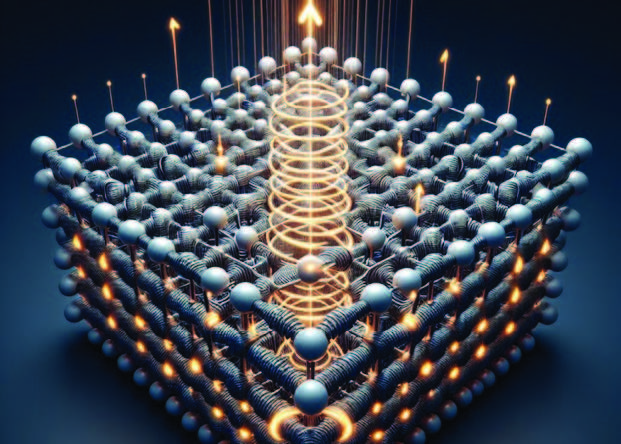
Circularly polarized laser light, resembling a “corkscrew,” imparts its polarization to atoms in a material, causing them to rotate and create atomic currents. When the light frequency matches atom vibration frequency, significant magnetism is produced.
AI Photo Source: Alexander Balatsky
In the coming decades, quantum technology is predicted to transform many crucial aspects of society and open up new opportunities in communication and energy. However, current research has only achieved quantum effects like magnetism and superconductivity in extremely cold conditions. As a result, the full potential of quantum research remains confined to laboratory settings. Recently, in a landmark publication in the prestigious journal Nature (Nature 2024, 628, 534–539), Bonetti and collaborators have unveiled a groundbreaking achievement. They have demonstrated, for the first time, the ability of laser light to induce quantum behavior at room temperature, thereby magnetizing non-magnetic materials. This seminal discovery is poised to revolutionize various fields, including computing, communication, and data storage, offering the potential for faster, more sustainable technological advancements.
The breakthrough method relies on the concept of “dynamic multiferroicity,” where titanium atoms within an oxide containing titanium and strontium, when stimulated by circularly polarized light, generate a magnetic field. This light-triggered magnetism occurs as photons excite electrons, causing them to realign their spins and induce magnetism in the material. Experimental validation of this hypothesis has been achieved for the first time, showcasing its potential for diverse applications in information technologies.
This achievement was made possible by developing a new light source in the far-infrared spectrum, featuring a unique “corkscrew” polarization. This marks the inaugural instance of inducing and observing material magnetization at room temperature in an experiment. Additionally, this method enables the creation of magnetic materials from various insulators, diverging from the conventional use of metals for magnets. According to Stefano Bonetti, research leader at Stockholm University and Ca’ Foscari University of Venice, this breakthrough opens doors to entirely new societal applications in the long term.
This groundbreaking method promises to revolutionize information transfer, data storage, and computer performance by enabling rapid magnetic switches, leading to faster and more energy-efficient technologies. The team’s findings, confirmed by multiple labs, show that this approach can write and store magnetic information, offering new avenues for material design using light.
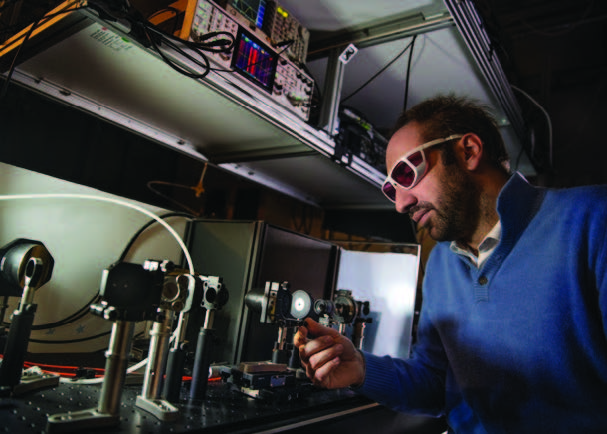
Stefano Bonetti in the lab at Stockholm University.
Photo Source: Knut and Alice Wallenberg Foundation/Magnus Bergström
In essence, the discovery of light-induced magnetism marks the dawn of a new era of exploration, where photons trigger magnetic phenomena, and the quantum realm becomes a playground for innovation. Guided by curiosity and fueled by discovery, we venture forth, expanding the horizon of possibilities and venturing into uncharted territories of light and magnetism.
– Anupa Ranabhat
Ankuram Academy (2020)
BE, TU (2022)