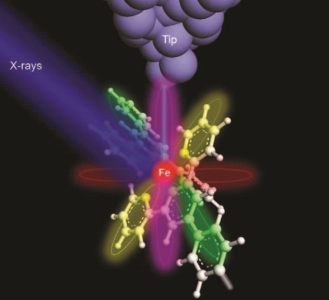
When X-rays illuminate an iron atom, the core level electrons are excited. X-ray excited electrons are then quantum tunnel to detector tip, which provide elemental and chemical information of the iron atom.
Photo Source: Saw Wai Hla (Re-print with permission)
Since its discovery by Roentgen in 1895, X-rays have found widespread use in various fields such as materials, and environmental studies.
However, reducing the amount of material required for X-ray characterization has been a long-standing objective.
A groundbreaking achievement led by Professor Hla and collaborators from Ohio University, Argonne National Laboratory, and the University of Illinois-Chicago involves the first-ever X-ray imaging of a single atom. This milestone has profound implications, potentially advancing medical and environmental sciences by enhancing our understanding of atoms at their smallest scale. Their findings were published in the journal Nature (Nature 2023, 618, 69-73).
To characterize a single atom using X-rays, the team initially encapsulated a lone iron atom within a tiny molecule made up of various elements at the nanometer scale. Subsequently, they subjected the sample to examination utilizing the formidable X-ray beam at Argonne’s Advanced Photon Source (APS). The team managed to pinpoint the solitary atom within the sample at a specific beamline called XTIP, which integrates a scanning tunneling microscopy (STM) probe.
When the sample is bombarded by the influx of photons from the X-ray beams, it emits electrons. Positioned marginally less than a nanometer above the sample surface, the STM probe collects the electrical signal resulting from these emitted electrons. The resulting spectra, which depict the relationship between current and photon energy, serve as distinctive “fingerprints” for the elements found in the periodic table. Consequently, through the exploration of the sample surface, scientists can identify a particular atom’s element and its precise location.
To demonstrate the broader potential of this new capability, the team effectively replicated the X-ray analysis using terbium, an uncommon earth element. This technique extends beyond metals to other elements. Understanding the characteristics of individual atoms enables scientists to explore novel applications for these materials.
This breakthrough combines synchrotron X-rays with
quantum tunneling to identify an individual atom’s X-ray signature, offering numerous research opportunities. It enables studies on quantum and spin properties using synchrotron X-rays and facilitates tracing of harmful compounds in environmental studies. While some questions remain, this experiment promises significant scientific impact, paving the way for future X-ray research.
– Aayush Kandel
Ankuram Academy (2023)