Installing a magnetic apparatus containing antihydrogen as part of the Antihydrogen Laser Physics Apparatus collaboration at CERN in Switzerland.
Photo Source: CERN
Antimatter, with its opposite properties to ordinary matter, has intrigued scientists and enthusiasts of speculative fiction for decades. Theoretical physicist Paul Dirac predicted its existence in the 1920s, sparking curiosity about its potential to transform our understanding of the universe. Gravity’s effect on antimatter has been a subject of speculation, with some suggesting antimatter could react differently to gravity than regular matter. However, according to the weak equivalence principle in general relativity, all masses should react the same way to gravity, regardless of their composition. Understanding this interaction is crucial for unraveling the mysteries of both antimatter and gravity.
Scientists have demonstrated the existence of gravity between antimatter and Earth, reaffirming Albert Einstein’s General Theory of Relativity. In a paper published in Nature (Nature 2023, 621, 716–722), Dr. Fajans a member of an international team called ALPHA, working on the Antihydrogen Laser Physics Apparatus collaboration, based at CERN and headed by Jeffrey Hangst, a particle physicist at Aarhus University in Denmark. Dr. Fajans and his team, shows that within the precision of their experiment, atoms of antihydrogen – a form of antimatter – fall to Earth in the same way as regular matter. The researcher’s team created approximately 100 antihydrogen atoms and held them in place using a magnetic field. As the field decreased gradually, the antihydrogen atoms descended, mirroring the fall of maple leaves in October, experiencing the same gravitational force as regular atoms.
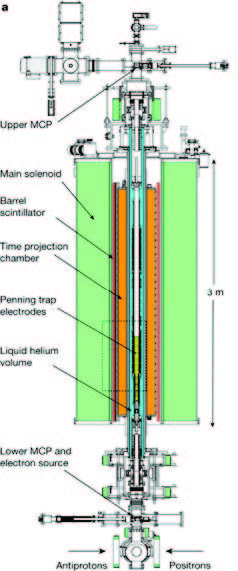
Cross section of the ALPHA-g apparatus. The full device comprises three antihydrogen trapping regions; only the bottom one is employed here. The MCP detectors are used to image charged particles extracted from the Penning traps for diagnostic purposes.
Photo Source: Anderson et al., Nature 2023, 621, 716–722
Jeffrey Hangst, spokesperson for ALPHA, stated, “In physics, true understanding comes from observation. This experiment marks the first direct observation of gravity impacting antimatter’s motion. It’s a significant milestone in our exploration of antimatter, a phenomenon that still perplexes us due to its apparent scarcity in the Universe.”
– Anurag Kandel
Ankuram Academy (2023)