


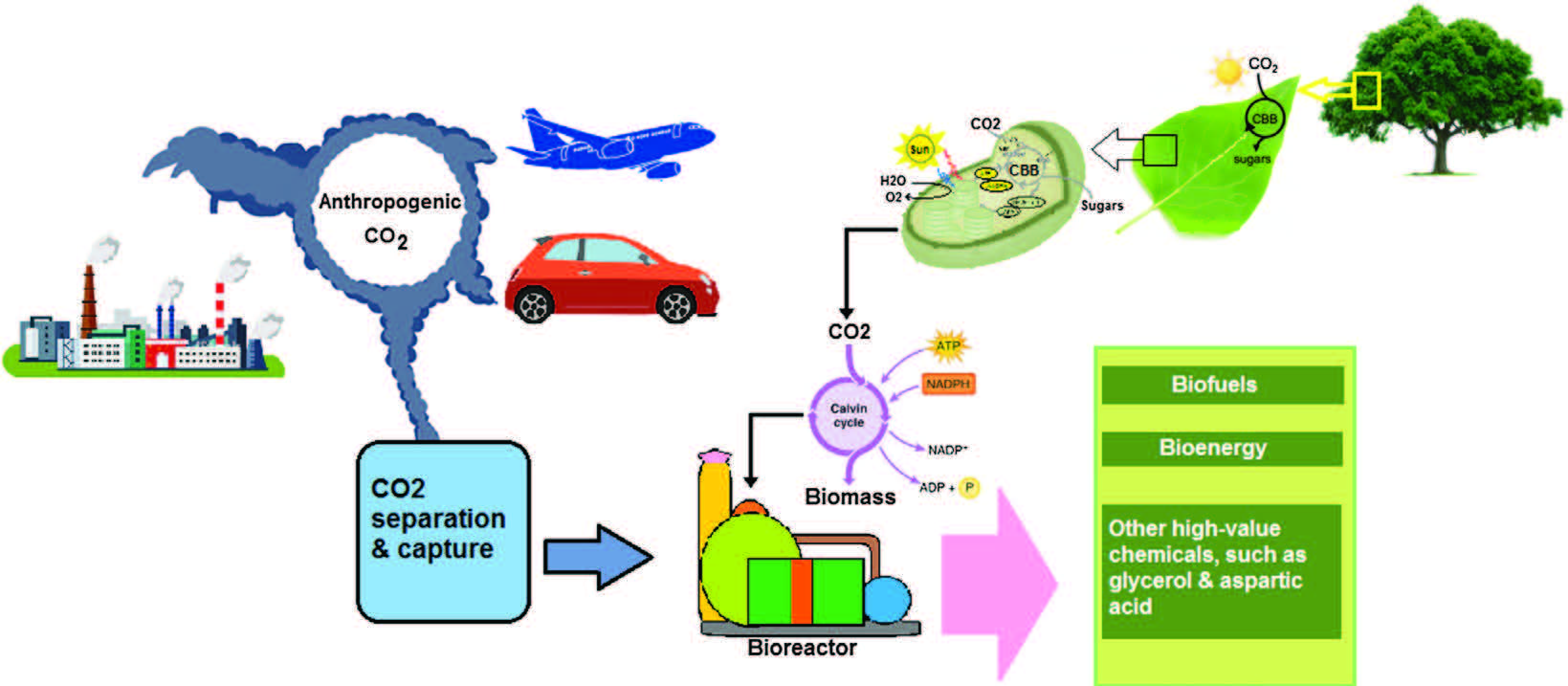
A schematic for turning CO2 into biofuels, bioenergy, and other value-added bio-based chemicals.
Photo Source: Nisar et. al., Microbiol. Res. 2021, 251, 126813
Carbon dioxide (CO2) is a common byproduct of industrial activities like power generation and transportation. Its growing emission, driven by industrialization and fossil fuel use, is a major concern for global climate change. To combat this, urgent measures are needed to cut CO2 emissions and develop sustainable energy sources. One promising solution is converting CO2 into fuel, which not only reduces greenhouse gases but also addresses energy needs sustainably. However, this process faces challenges such as finding efficient catalysts and making it economically viable. Innovative collaborations and approaches are essential to tackle these hurdles and explore CO2 conversion technologies for fuel production.
In recent years, significant progress has been made in developing catalysts that facilitate the conversion of CO2 into fuels. Both electrochemical and biological conversion methods have become firmly established in this pursuit.
A. Electrochemical Conversion of CO2
One promising approach is electrochemical conversion, which uses electricity to drive chemical reactions that transform CO2 into fuels or chemical feedstocks. An international team of researchers from the University of Nottingham’s School of Chemistry, University of Birmingham, University of Queensland and University of Ulm have designed a material, made up of copper anchored on nanocrystalline carbon nitride. The copper atoms are nested within the nanocrystalline structure, which allows electrons to move from carbon nitride to CO2, an essential step in the production of methanol from CO2 under the influence of solar irradiation. Electrochemical processes offer high selectivity and can be powered by renewable energy sources, making them environmentally friendly alternatives to traditional fossil fuel-based methods.
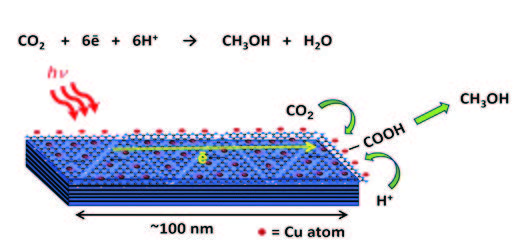
Schematic representation of CO2 photoreduction on a nanocrystalline domain of carbon nitride decorated with single copper atoms (Cu/nc-C3N4 catalyst system).
Photo Source: LeMercire et al., Sutain. Energy Fuels 2024, 8, 1691-1703
B. Biological Conversion
Another innovative technique is biological conversion, where microorganisms are employed to metabolize CO2 and produce organic compounds, including biofuels. These biological systems mimic natural processes such as photosynthesis and offer the potential for scalable and sustainable fuel production. Moreover, bioconversion technologies can utilize CO2 from diverse sources, including industrial emissions and atmospheric capture systems. In bioconversion of CO2 into energy, the CO2 is first captured into a biological system, and then it is converted into biofuels or bioenergy. The capability of CO2 fixing microbes can be enhanced via metabolic engineering. Explorations of new candidate genes or variants associated with enhanced CO2 fixation in the biological systems, augmented the field of metabolic engineering. Genes or variants having a high efficiency of CO2 fixing are introduced into the candidate microbes to further increase their potential of CO2 capture and its conversion into biofuels or bioenergy.
The transformation of CO2 into fuel holds immense potential for addressing both environmental and energy challenges. By utilizing CO2 as a feedstock, we can mitigate greenhouse gas emissions, reduce reliance on finite fossil fuel reserves, and transition towards a sustainable energy future. However, realizing this potential requires continued research and development to improve the efficiency, scalability, and cost-effectiveness of CO2 conversion technologies.
Policy support and incentives play a crucial role in driving innovation and investment in CO2 utilization projects. Collaboration among governments, industries, and research institutions is vital to create a conducive environment for scaling up CO2 conversion technologies. Public awareness and education efforts can further promote acceptance of these innovative approaches to address climate change. Converting CO2 into fuel offers a promising route to a carbon-neutral energy economy. With technological innovation, collaboration across disciplines, and supportive policies, we can utilize CO2 emissions as a valuable resource for sustainable fuel production. Investing in CO2 conversion technologies enables us to tackle climate change, reduce reliance on fossil fuels, and move towards a cleaner future.
– Sumnath Khanal
HoD, Chemistry
Ankuram Academy


