


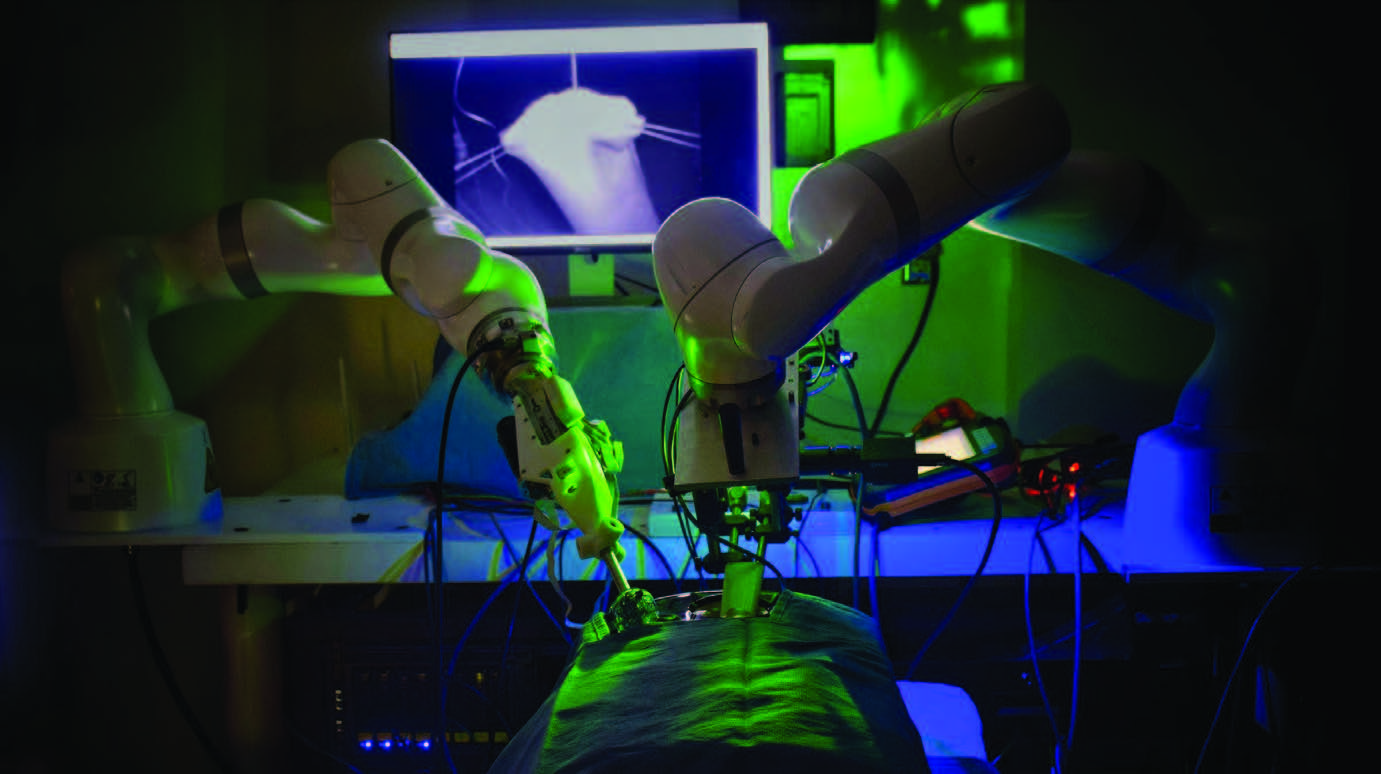
Overview of the Smart Tissue Autonomous Robot (STAR) for autonomous laparoscopic soft tissue anastomosis.
Photo Source: Saeidi et al., Sci. Robot. 2022, 7
Senior author Axel Krieger, an assistant professor of mechanical engineering at Johns Hopkins’ Whiting School of Engineering, expressed the significance of their findings, highlighting that the STAR robot has successfully completed the delicate task of reconnecting two ends of an intestine in four animals, surpassing human performance in the same procedure.
In a groundbreaking achievement, a team of researchers from Johns Hopkins University has unveiled the Smart Tissue Autonomous Robot (STAR), capable of conducting laparoscopic surgery on soft tissue of a pig without human intervention. This advancement marks a significant stride towards fully automated surgical procedures for humans, and they published their work in the journal Science Robotics (Sci. Robot. 2022, 7).
The STAR’s proficiency in intestinal anastomosis, a highly precise and repetitive surgical step, underscores its potential in gastrointestinal three-dimensional endoscope and a machine learning-based surgery. Even minor errors, like hand tremors or misplaced stitches, can lead to critical complications in patients. Collaborating with experts from Children’s National Hospital in Washington, D.C., and Johns Hopkins, Krieger and his team integrated specialized suturing tools and advanced imaging systems into the robot to enhance its autonomy and surgical accuracy.
Krieger emphasized the challenge soft-tissue surgeries pose for robots due to their unpredictable nature. The STAR’s innovative control system enables real-time adjustments during surgery, mimicking human adaptability.
First author Hamed Saeidi, a visiting research scientist at Johns Hopkins, noted that the STAR is the first robotic system to autonomously plan, adapt, and execute soft-tissue surgical procedures with minimal human involvement. The robot’s guidance system utilizes a structural light-based three-dimensional endoscope and a machine learning-based tracking algorithm developed by Johns Hopkins professor Jin Kang and his team, enhancing its precision and safety.
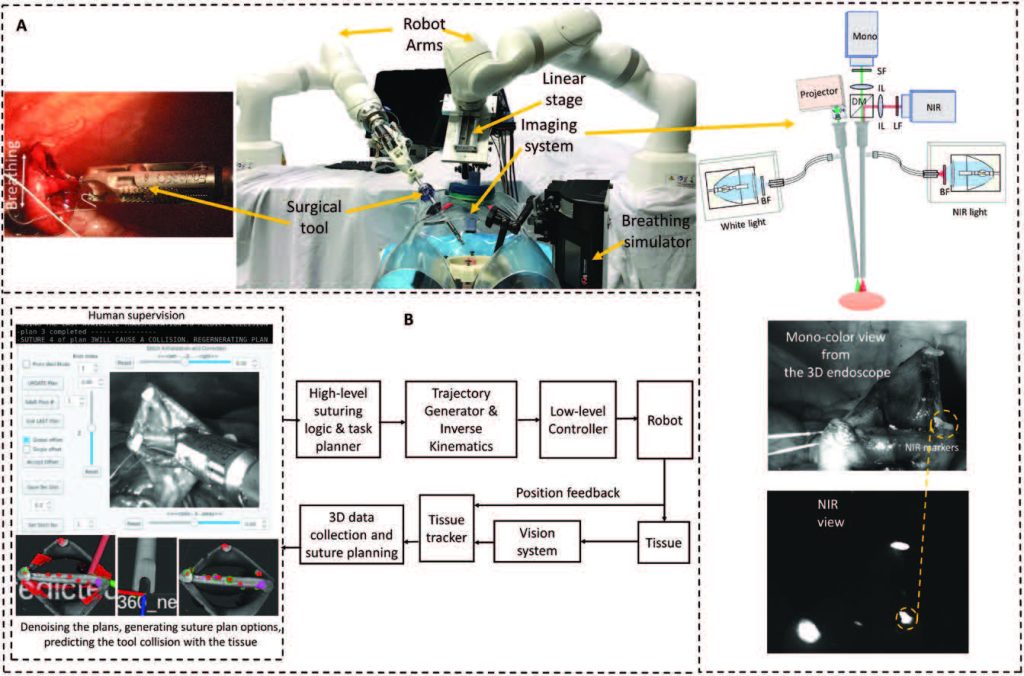
Enhanced autonomous laparoscopic soft tissue surgery.
(A) The components of the STAR system, including medical robotic arms, actuated surgical tools, and dual-channel NIR and 3D structured light endoscopic imaging system. (B) Control architecture of the enhanced autonomous control strategy for STAR.
Photo Source: Saeidi et al., Sci. Robot. 2022, 7
According to Kang, advanced machine vision system are crucial for intelligent surgical robots to ensure smarter and safer operations. Krieger emphasized the importance of automated robotic systems in the evolving landscape of laparoscopic surgeries, foreseeing improved precision and consistency in patient outcomes across all surgical skill levels.
The collaborative effort from Johns Hopkins University, including researchers Justin D. Opfermann, Michael Kam, Shuwen Wei, and Simon Leonard, along with contributions from Michael H. Hsieh of Children’s National Hospital, underscores the interdisciplinary approach driving advancements in robotic surgery.
Video Source:
Watch how researchers from Johns Hopkins University demonstrate a challenging surgery performed by the Smart Tissue Autonomous Robot. Check out the video at the following link:
https://www.youtube.com/watch?v=cybRmhsvOss
– Er. Tej Pd. Aryal
HoD, Computer Science
Ankuram Academy


