


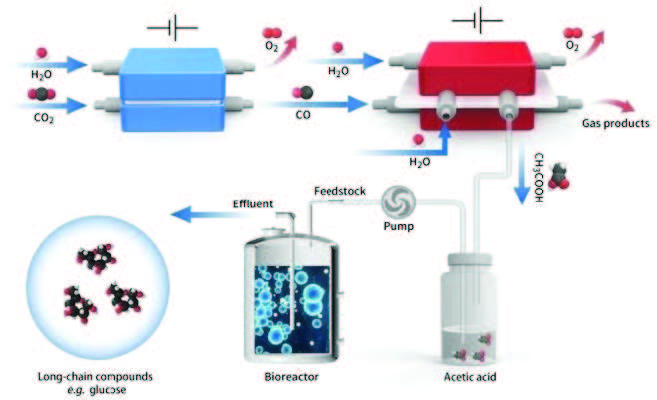
Schematic diagram of in vitro carbon dioxide synthesis of high energy long chain food molecules.
Photo Source: Shenzhen Institute of Advanced Technology/Xia et al., Nat Catal 2022, 5, 388–396a
Climate change, caused by a high amount of carbon dioxide (CO2) in the air, affects the world’s economy and environment. To address this issue, researchers are exploring ways to recycle CO2 and transform it into useful products sustainably. This approach could benefit the environment and establish a circular carbon economy. While there have been successes in converting CO2 into simpler products like carbon monoxide, ethanol, ethylene, and formate using renewable energy or sunlight, the direct conversion of CO2 into complex long chain products such as fatty acids and glucose is not commonly achieved yet.
Recently, Professor Chuan Xia of the University of Electronic Science and Technology, Professor Tao Yu of the Chinese Academy of Sciences’ Shenzhen Institute of Advanced Technology, and Professor Jie Zeng of the University of Science and Technology have developed a hybrid electro-biosystem that couples spatially distinct CO2 electrolysis with yeast fermentation to efficiently convert CO2 to glucose. Their findings were recently published in the journal Nature Catalysis (Nat Catal 2022, 5, 388–396).
They used a Ni–N–C single-atom catalyst to convert CO2 into CO in a membrane electrode assembly and then produced a grain-boundary-rich Cu (GB_Cu) catalyst for acetate production from electrochemical CO reduction. The investigators devised a porous solid electrolyte reactor with thick anion exchange membranes for pure acetic acid solution purification and separation to meet this challenge. They removed all defined hexokinase genes (hxk1, hxk2, glk1, YLR446W, and emi2) in Saccharomyces cerevisiae in the following microbial fermentation to facilitate microbe growth on pure acetic acid and effectual glucose release in vitro. They showcase that the proposed platform can be easily extended to produce other products like fatty acids using CO2 as the carbon source. These results illuminate the tantalizing possibility of a renewable-electricity-driven manufacturing industry. This achievement may generate broad impacts in terms of the conservation of water resources and land use around the world.
The successful conversion of CO2 into glucose with unprecedented efficiency is a landmark achievement in synthetic biology and environmental science. This innovation not only provides a new tool for combating climate change but also paves the way for sustainable energy and food production solutions. As research progresses, this technology could play a critical role in shaping a greener and more sustainable future.
– Editorial Board
Ankuram Academy


