


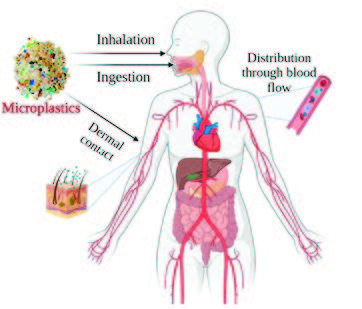
Pathways of micro-plastic exposure in humans.
Photo Source: Yanbo Li et al., Sci. Total Environ. 2024, 912, 168946
Plastics are integral to modern life, serving in technology, medicine, and everyday items. Yet, our throwaway culture poses environmental challenges, with plastics accumulating in landfills and water bodies. The degradation of plastics into micro and nano particles is raising concerns about their impact on the environment and human health. The tiniest particles known as nanoplastics (ranging from 1 nm to 1 µm) and microplastics (measuring from 1 µm to 5 mm) have unique chemical characteristics and are lightweight, allowing them to travel extensively through air, water, and soil. Their pervasive distribution presents health hazards, as microplastics are present in numerous items such as clothing, food packaging, and personal care products, resulting in direct human exposure. Zemelka-Wiacek et al., (Environ. Res. 2024, 251, 118535) and Yanbo Li et al., (Sci. Total Environ. 2024, 912, 168946) have independently authored review articles, in which they provide comprehensive summaries of the impact of nano and microplastics on human health.
Microplastics can enter the human body through various pathways: ingestion (consumption of food or water contaminated with microplastics), inhalation (breathing in airborne microplastics), and dermal penetration (absorption through the skin). While ingestion and inhalation are often considered the primary routes of exposure, dermal penetration, or absorption through the skin, is also recognized as a significant pathway. It’s important to give equal attention to all three routes when studying the potential health impacts of microplastic exposure.
Plastics, especially nano and microplastics, have the potential to accumulate in the human body over time. This accumulation can have various adverse effects on health. For instance, respiratory disorders like lung cancer, asthma, and hypersensitivity pneumonitis have been linked to exposure to plastics. Additionally, neurological symptoms such as fatigue and dizziness, as well as inflammatory bowel disease, can result from the bioaccumulation of plastics. Furthermore, disturbances in gut microbiota, which play a crucial role in maintaining overall health, can also occur due to plastic exposure.
Studies have shown that nano and microplastics can induce cell apoptosis, a process of programmed cell death, which can disrupt normal cellular functions. Moreover, these plastics exhibit genotoxic and cytotoxic effects, meaning they can damage genetic material and harm cells. Understanding the cellular and molecular mechanisms underlying these effects is essential for accurately assessing the risks associated with plastic exposure and developing effective mitigation strategies to protect human health. To minimize exposure to nano and microplastics in everyday life, individuals can adopt straightforward measures such as reducing the usage of disposable plastics, selecting items with minimal plastic packaging, and favoring natural materials when available. Advancements in materials science are yielding promising results in the development of biodegradable plastics, offering potential solutions to mitigate the environmental and health consequences linked to conventional plastics. Biodegradability stands as a pivotal factor in curbing long-term accumulation and related hazards. Additionally, it is imperative to enhance public awareness regarding the health risks associated with plastics. Effective dissemination of accurate information through the media is essential in empowering individuals to make informed decisions regarding plastic consumption.
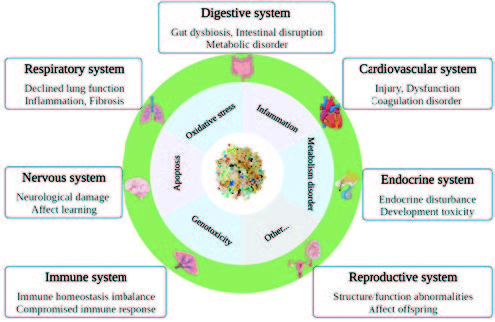
Mechanism and potential toxicity of microplastics on human health.
Photo Source: Yanbo Li et al., Sci. Total Environ. 2024, 912, 168946
– Digam Pandey
Ankuram Academy (2023)


