


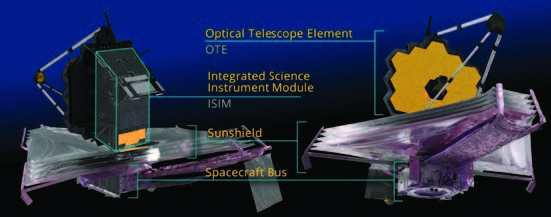
James Webb Space Telescope, major components.
Photo Source: science.nasa.gov
NASA’s latest astronomical marvel, the James Webb Space Telescope (JWST), has captured global attention with its groundbreaking capabilities and potential to revolutionize our understanding of the cosmos. Launched on December 25, 2021, this state-of-the-art observatory represents a significant leap forward in space exploration and promises to unveil unprecedented insights into the universe.
The concept for the James Webb Space Telescope traces back to the early 1990s when astronomers and space agencies envisioned a successor to the iconic Hubble Space Telescope. Over decades of meticulous planning, development, and collaboration between NASA, the European Space Agency (ESA), and the Canadian Space Agency (CSA), the JWST became a reality. Its construction and testing phases spanned years, culminating in a successful launch aboard an Ariane 5 rocket from French Guiana. The primary objective of the JWST is to explore the cosmos in infrared wavelengths, offering a unique perspective that allows it to peer through cosmic dust, study the early universe, and examine the formation of stars, galaxies, and planetary systems. Additionally, the telescope aims to analyze the atmospheres of exoplanets, potentially identifying signs of habitability or even extraterrestrial life. The James Webb Space Telescope comprises several key components, including a 6.5-meter primary mirror coated with gold for optimal infrared reflection. Its scientific instruments include the Near-Infrared Camera (NIRCam), Near-Infrared Spectrograph (NIRSpec), Mid-Infrared Instrument (MIRI), and Fine Guidance Sensor/Near InfraRed Imager and Slitless Spectrograph (FGS/NIRISS). These cutting-edge instruments work synergistically to capture high-resolution images, spectra, and data from celestial objects across the universe.

December 2023 saw the release of Webb’s NIRCam image of Cassiopeia A (Cas A), an object known as a supernova remnant.
Photo Source: NASA, ESA, CSA, STScI, Danny Milisavljevic (Purdue University), Ilse De Looze (UGent), Tea Temim (Princeton University)
Recent headlines have celebrated the successful deployment and early operations of the JWST, marking a significant milestone in its mission. Scientists and astronomers worldwide are eagerly anticipating the groundbreaking discoveries and insights that the telescope will deliver in the coming years. From unraveling the mysteries of dark matter to studying exoplanet atmospheres, the James Webb Space Telescope promises to redefine our cosmic understanding and inspire generations to come.

In March 2024, the Webb Telescope release an image of NGC 604, a star-forming region within the Triangulum Galaxy.
Photo Source: NASA, ESA, CSA, STScI
– Sakar Upereti
Co-Editor
Ankuram Academy (2023)


