


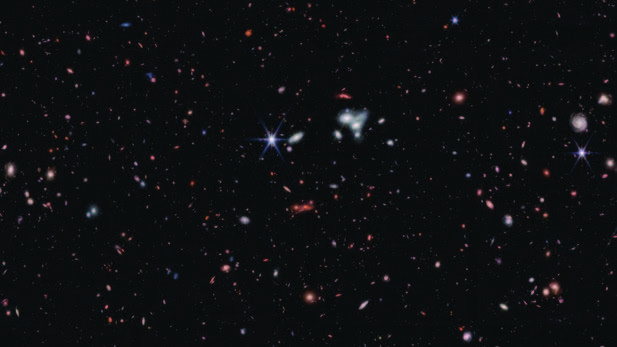
A panoramic vista of over 100,00 galaxies known as the Cosmic Evolution Early Release Science (CEERS) Survey.
Photo Source: NASA, ESA, CSA, Steve Finkelstein (UT Austin), Micaela Bagley (UT Austin), Rebecca Larson (UT Austin)
Using the James Webb Space Telescope, scientists found the most distant supermassive black hole ever seen. It’s in the galaxy CEERS 1019, appearing about 570 million years after the Big Bang. Surprisingly, this black hole is smaller than others found in the early universe. They also found two more small black holes in galaxies that were about 1 to 1.1 billion years old after the Big Bang. These discoveries came from Webb’s CEERS Survey led by Steven Finkelstein from the University of Texas at Austin. This program combines detailed images from Webb with spectral data to study cosmic phenomena.
CEERS 1019 is unique because its black hole is much lighter than others found in the early universe. While most early black holes weigh over 1 billion times the mass of our Sun and shine brightly, this one is only about 9 million times the mass of the Sun. Even though it’s smaller, it doesn’t shine as brightly as the bigger ones. Its discovery challenges what we know about how black holes form early in the universe. Scientists thought smaller black holes existed back then, but they couldn’t confirm it until they used the James Webb Space Telescope. However, its status as the farthest black hole might not last long, as other claims are being checked by astronomers.
Webb’s detailed data has made it easy to confirm these discoveries. Rebecca Larson from the University of Texas at Austin compared it to studying black holes closer to us. The many spectral lines provided a lot of information for analysis. This helped the team understand the emissions from the black hole and its galaxy, as well as how much gas the black hole is consuming and how quickly stars are forming. The team found that the galaxy CEERS 1019 is consuming gas and making new stars at the same time. By looking at images of the galaxy, they noticed it has three bright clumps instead of one circular disk. Jeyhan Kartaltepe from the Rochester Institute of Technology said they’re not used to seeing such detailed structures from such far away.
This structure suggests that a merger of galaxies might be causing more activity in the black hole, leading to more star formation. The CEERS Survey keeps finding interesting things. Dale Kocevski and the team from Colby College quickly found two small black holes. One is in galaxy CEERS 2782, easy to see because there’s no dust blocking the view, existing just 1.1 billion years after the Big Bang. The other one, in galaxy CEERS 746, is a bit older, existing one billion years post-Big Bang, but dust makes it harder to see. Kocevski explained that even though the central black hole is visible, the dust suggests it’s in a galaxy making lots of stars.
These two black holes, like the one in CEERS 1019, are considered “lightweights” compared to others, each about 10 million times the mass of the Sun. Kocevski said researchers knew there had to be smaller black holes in the early universe, and Webb is the first telescope to see them clearly. Before Webb, these three black holes were too faint to see. Finkelstein added that with other telescopes, they look like regular galaxies making stars, not active supermassive black holes. The first findings from the CEERS survey are a big deal. Finkelstein said before, studying things in the early universe was mostly guesswork. But with Webb, we can actually see black holes and galaxies far away, and now we can measure them accurately too. That’s a big deal for this telescope. In the future, Webb’s data could help us understand how black holes formed early on, which could change what we know about how the universe began and evolved.

This graphic shows detections of the most distant active supermassive black holes identified by in the James Webb Space Telescope’s Cosmic Evolution Early Release Science (CEERS) Survey.
Photo Source: NASA, ESA, CSA, Leah Hustak (STScI)
– Deepika Tiwari (2023)
Ankuram Academy


