


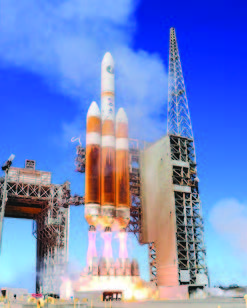
A Delta IV Heavy during liftoff. The rocket is entirely fueled with liquid hydrogen and liquid oxygen cryogenic propellants.
Photo Source: Wikipedia
Chemistry is crucial for making rockets work. Rockets follow Newton’s Third Law: when gas is expelled from one end, the rocket moves in the opposite direction. Whether it’s a small car or a huge rocket like the SLS (Space Launch System), they all rely on the same basics. Combustion, which is burning something, produces energy that moves objects forward. It begins with fuel (something to burn) and an oxidizer (something to help burn), creating propellant. A spark starts the reaction, releasing energy and byproducts. To make the SLS take off, there are two main areas where combustion happens: the main engines and the solid rocket boosters. These boosters, made by Orbital ATK, provide most of the thrust during liftoff. Although both systems use combustion, they use different fuels and oxidizers. The main engines, called “liquid engines,” use liquid hydrogen (LH2) as fuel and liquid oxygen (LOX) as the oxidizer. On the other hand, the boosters use aluminum as fuel and ammonium perchlorate mixed with a binder as the oxidizer to make a solid propellant.
To fuel the main engines, hydrogen, which is the lightest element and usually a gas, is used. To produce enough power for a big combustion reaction, a huge tank would be needed to store it, which isn’t practical for a streamlined rocket. To solve this problem, hydrogen gas is turned into a liquid, which is denser. This requires cooling the hydrogen to a very cold temperature of -253 degrees Celsius.
Oxygen, even though it’s denser than hydrogen, still has to be turned into a liquid to fit into a smaller, lighter tank. To do this, oxygen is cooled down to -183 degrees Celsius. Additionally, liquid hydrogen and oxygen evaporate quickly at normal pressure and temperature, so they need to be loaded into the rocket shortly before launch.
As the launch countdown hits zero, fuel is pumped into the engines. When ignited, hydrogen mixes with oxygen to make water, releasing huge energy and steam. This powerful reaction makes the steam rush out of the engine at 10,000 miles per hour, pushing the rocket into space.
Cryogenic LH2 isn’t only good because it makes water in a nice way. It’s also great because of its efficiency, measured by specific impulse. This shows how much push you get for the fuel you use. The higher the specific impulse, the more push you get per pound of fuel burned.
The LH2-LOX fuel mix has the best specific impulse among common rocket fuels, and the RS-25 engine makes the most of this efficient fuel. But LH2, despite its efficiency, is not very dense. So, to carry enough LH2 for a powerful launch, you’d need a tank that’s too big, heavy, and insulated to be practical. To solve this problem, designers added a boost to the SLS to overcome these limitations and harness the potential of hydrogen as a powerful rocket fuel.
– Ritesh Sigdel
Ankuram Academy (2023)


