


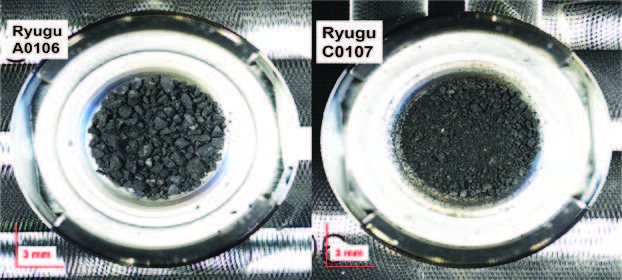
Photographs of samples A0106 and C0107 collected from the asteroid Ryugu, during the 1st touchdown sampling and 2nd touchdown sampling, respectively.
Photo Source: Oba et. al., Nat Commun 2023, 14, 1292
In a historic revelation, Japan’s Hayabusa2 mission, spearheaded by the Japan Aerospace Exploration Agency (JAXA), has brought back a treasure trove of asteroid material from Ryugu. The mission, executed in December 2020, saw the Japanese spacecraft land at two distinct locations on Ryugu’s surface and successfully return to Earth with 5.4 grams of pristine samples, delivered via capsule and parachute. These findings were published in the journal Nature Communication (Oba et. al., Nat Commun 2023, 14, 1292).
A breakthrough discovery emerged as an international team, led by Associate Professor Yusohiro Oba at Hokkaido University, identified uracil in the samples, a crucial nucleobase fundamental to RNA, alongside vitamin B3 (niacin). The deeper Ryugu sample had a higher uracil concentration (32 parts per billion) compared to the shallower sample (11 parts per billion), attributed to cosmic rays and sunlight’s UV degradation. Ryugu’s composition links it to CI chondrites, where three nucleobases were found.
The analysis indicates these materials are the most primitive ever studied, a significant find for astrobiology and our understanding of life’s origins. It suggests RNA and DNA molecules might have originated in space before reaching Earth, supporting cosmogony theories. Alternatively, uracil and nucleobases could have formed before our solar system, via photochemical reactions in deep space. This implies life’s basic ingredients could be widespread in the universe, potentially fostering alien life. Recent research on Ryugu’s boulders’ high porosity sheds light on its composition and planetesimal formation processes.
In Ryugu’s sample, two types of organic compounds known as imidazoles were found. Imidazoles are part of uracil’s molecular structure. One type, called 4-ICA (4-imidazolecarboxamide), was found in similar concentrations as uracil, while the other, 2-ICA (2-imidazolecarboxamide), had lower concentrations. 4-ICA imidazole can form in chemical reactions with hydrogen cyanide, a common ingredient in interstellar clouds.
Detecting uracil and other compounds on Ryugu significantly enhances our grasp of life’s origins, urging us to embrace various hypotheses and complex early evolution processes. Beyond Ryugu, Hayabusa2 now sets its sights on asteroid 1998 KY26, scheduled for 2031, as the enigma of life’s origin continues to captivate scientific inquiry.
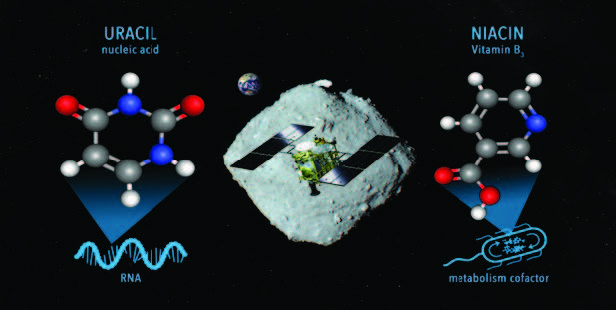
A conceptual image for sampling materials on the asteroid Ryugu containing uracil and niacin by the Hayabusa2 spacecraft (NASA Goddard/JAXA/Dan Gallagher).
Photo Source: Oba et. al., Nat Commun 2023, 14, 1292
– Anis K.C.
Ankuram Academy (2023)


