


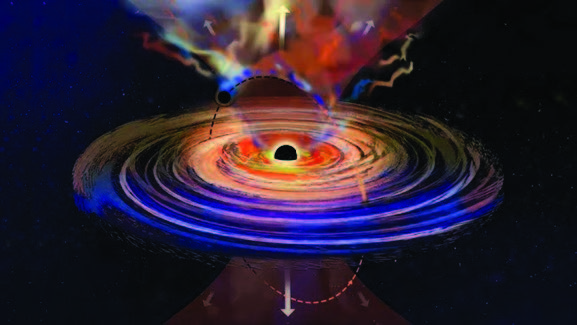
A second black hole dives through the accretion disc of its supermassive companion, causing cosmic “hiccups.”
Photo Source : Jose – Luis Ol ivares, MIT
A really big black hole that usually stays quiet surprised astronomers when it started acting differently. Back in 2020, this black hole, which sits at the center of a galaxy about 800 million light-years away from Earth and weighs as much as 50 million suns, suddenly became much brighter, lighting up the stuff around it by a thousand times.
A group of space scientists from the Massachusetts Institute of Technology (MIT) found something really surprising in space: a black hole that used to be quiet is now suddenly getting all active every 8.5 days, before going back to being calm again. This is the first time anyone has seen a black hole behave like this, so it’s a big deal in space science. They published these findings in the journal Science Advances (Pasham et. al., Sci. Adv. 2024, 10).
It used to be quiet, but now it’s acting up. Why? Well, it turns out there’s a smaller black hole twirling around the big one. Every 8.5 days, it tosses out stuff from the big black hole’s gas disk. This discovery is shaking up what scientists thought they knew about black holes. They used to think the gas disks around black holes were smooth and even. But now, they’re realizing these disks might be more of a mix and could contain other things, like other black holes or even whole stars.
They found something interesting using a bunch of robot telescopes called ASAS-SN (the All Sky Automated Survey for SuperNovae). These telescopes are spread out in different parts of the world, looking at the whole sky every day to find exploding stars and other quick events. Back in December 2020, the survey noticed a big flash of light in a galaxy far away, about 800 million light-years from us. That area of the sky had been pretty calm and dark until the telescopes saw this burst, and then the galaxy suddenly got a lot brighter, like a thousand times brighter than before.
The galaxy’s burst of energy dipped regularly every 8.5 days. It’s like when a planet passes in front of a star, blocking its light for a bit. But it’s strange because no star could block a burst from a whole galaxy. “I was puzzled trying to figure out what this means because this pattern doesn’t match anything we know about these systems,” the researcher, Pasham remembers.
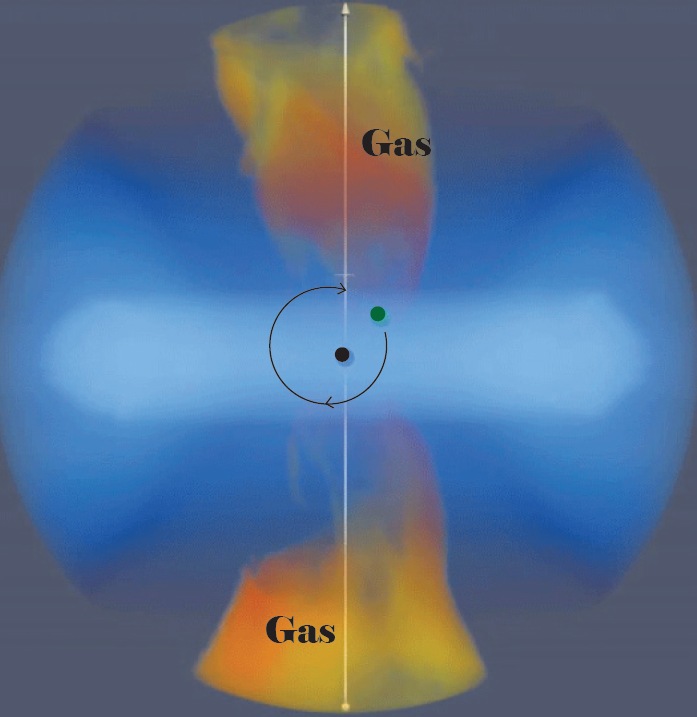
A computer simulation of an intermediate-mass black hole orbiting a supermassive black hole, and driving periodic gas plumes that can explain the observations.
Photo Source: Petra Sukova, Astronomical Institute of the CAS
While searching for an explanation for the regular dips, Pasham found a recent paper by theoretical physicists from the Czech Republic. According to their proposal, a big black hole occasionally emits bursts of gas, like hiccups. Through analysis, it was discovered that a small black hole was repeatedly breaking through the gas disk around the larger black hole, causing these bursts. Strong magnetic fields on the north and south sides of the black hole, depicted by the orange cone, propelled the bursts upward and out of the disk. Each time the smaller black hole broke through the disk, it released another burst, following a consistent pattern.
Author Pasham, thinks, “We thought we knew a bunch about black holes, but this hiccup shows they can do even more.” He thinks there might be more systems out there to find with more watching and collecting data.
– Sushma Sapkota
Ankuram Academy (2023)


