


This false-color SEM (scanning electron microscopy) image shows Ideonella sakaiensis.
Photo Source: Yoshida et al., Science 2016, 351, 1196-1199
A team of Japanese researchers, led by Dr. Kohei Oda and Dr. Kenji Miyamoto, recently made a groundbreaking discovery in the field of environmental science. They collected 250 samples of PET (Polyethylene Terephthalate) debris and meticulously screened them for bacteria that thrive on PET film as their primary carbon source for growth Their efforts paid off when they identified Ideonella sakaiensis 201-F6, a bacterium with a remarkable ability to almost completely degrade a thin film of PET within six weeks. Through further investigation, the team uncovered an enzyme, ISF6-4831, which collaborates with water to break down PET into an intermediate substance. This substance is then further broken down by a second enzyme, ISF6-0224, into environmentally friendly monomers.
The researchers explained that their screening of natural microbial communities exposed to PET in the environment led to the isolation of Ideonella sakaiensis 201-F6, which utilizes PET as its primary energy and carbon source. They emphasized that both enzymes are crucial for efficiently converting PET into its benign monomers, terephthalic acid, and ethylene glycol.
The discovery of Ideonella sakaiensis and its plastic-degrading enzymes gained widespread attention after being published in the journal Science (Science 2016, 351, 1196-1199). This research shed lighton the bacterium’s unique capability to break down polyethylene terephthalate, commonly found in bottles and containers. This finding not only offered a potential solution to the global plastic pollution crisis but also highlighted nature’s adaptability in response to environmental challenges.
The publication in Science underscored the importance of microbial research in addressing urgent environmental issues, spurring further exploration into plastic-degrading enzymes and bacteria worldwide.
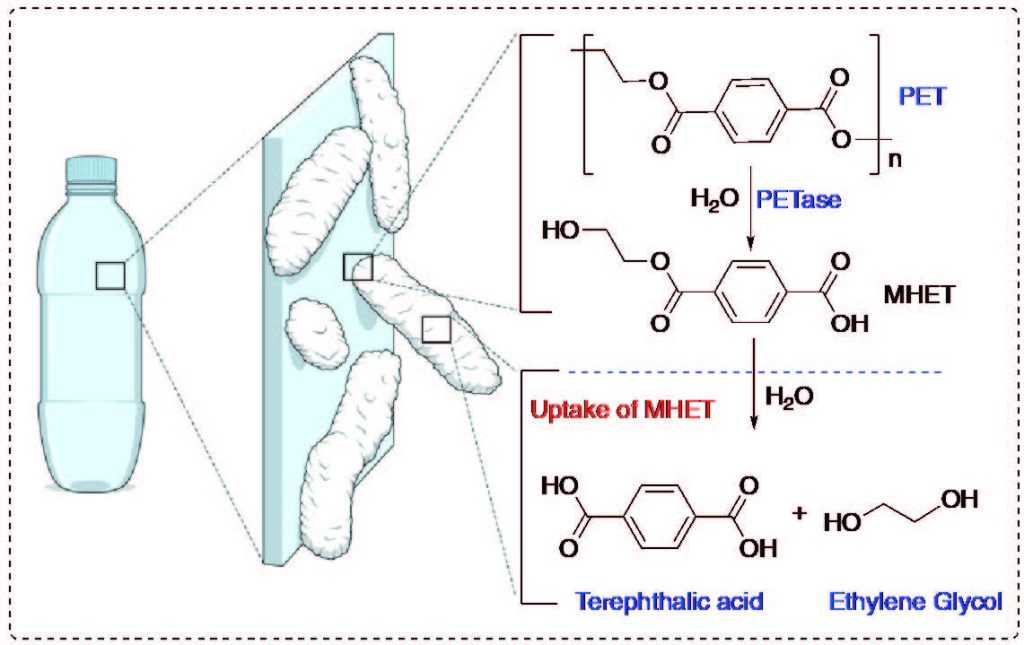
Ideonella sakaiensis PETase enzyme chemical mechanism. PETase catalyzes the hydrolytic cleavage of PET to produce BHET: Bis(2-hydroxyethyl) terephthalate, MHET: Mono(2-hydroxyethyl) terephthalate, and TPA: Terephthalic acid.
Photo Source: Yoshida et al., Science 2016, 351, 1196-1199
Scientists are now actively working to unlock the full potential of these discoveries for sustainable waste management and recycling initiatives, aiming to mitigate the impact of plastic pollution on our planet.
-Sumnath Khanal
HoD, Chemistry
Ankuram Academy


