


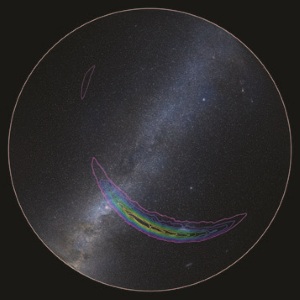
This sky map shows the probable source of gravitational waves detected by LIGO in 2015. Purple outlines a 90% confidence area, while yellow marks a 10% confidence zone.
Photo Source: LIGO/Axel Mellinger
In the domain of astrophysics, there are moments that redefine our comprehension of the cosmos. One such momentous occasion occurred when scientists detected gravitational waves, as predicted by Albert Einstein a hundred years ago. Researchers from institutions like MIT and Caltech, collaborating within the Laser Interferometer Gravitational-Wave Observatory (LIGO) Scientific Collaboration, achieved a groundbreaking milestone by directly detecting, gravitational waves with Earth-based instruments for the first time. This historic event occurred on September 14, 2015, at 5:51 A.M. EDT (Eastern Daylight Time). They shared these findings in the journal Physical Review Letters (Phys. Rev. Lett. 2016, 116).
The detection of gravitational waves by the LIGO underscores human innovation and technological advancement. LIGO comprises twin detectors, one in Livingston, Louisiana, and the other in Hanford, Washington, each featuring lengthy perpendicular arms along which laser beams are directed and reflected.
When a gravitational wave passes through Earth, it induces minute fluctuations in the length of the arms of LIGO. This extraordinary sensitivity enables the observation of gravitational waves with unparalleled accuracy, allowing scientists to discern changes as caused by passing gravitational waves, scientists detected the signal. Uponcapturing the gravitational signal, they translated it into audible waves, allowing them to listen to the distinctive sound produced by the spiraling and eventual merging of two black holes into a single, larger black hole. Furthermore, scientists have interpreted the signal of the gravitational wave and pinpointed its source. Their investigation led them to determine that the gravitational wave was produced by the merging of two colossal black holes positioned 1.3 billion light years distant. This remarkable observation signifies an exceptionally uncommon occurrence that had never been seen before.
The inaugural detection of gravitational waves by LIGO sets the stage for future breakthroughs and advancements in astrophysics. Since this momentous achievement, LIGO and its global collaborators have identified numerous additional gravitational wave events, further enriching our understanding of the universe. As we continue to probe the universe through gravitational wave research, we embark on a transformative journey that promises to reshape our understanding of the cosmos and humanity’s place within it.
-Prabesh Sapkota
Ankuram Academy (2020)
BE, TU (2022)


