


Bowhead whales (a mother and calf shown here) are the world’s longest living mammals. Enhanced ability to repair DNA may be key to their longevity.
Photo Source: National Ocean Service/NOAA
In the vast, icy expanses of the Arctic, the bowhead whale (Balaena mysticetus) stands out as one of the ocean’s most extraordinary creatures. Renowned for their immense size and possessing the longest baleen plates among all whale species, these majestic beings harbor secrets that could revolutionize our understanding of longevity and disease resistance. With lifespans exceeding two hundred years, bowhead whales exhibit a remarkable capacity to fend off cancer, a characteristic that has intrigued and fascinated scientists for years.
over 80 tons and having lots of cells, they don’t get cancer. This is strange and confusing for scientists, called Peto’s Paradox. It means that even though they have more cells and live longer than humans, huge animals like elephants and bowhead whales don’t get cancer.
Scientists, including those from the University of Rochester in New York, have found out that bowhead whales can live for more than 200 years because they’re really good at fixing broken DNA, which helps them age slower. In a study posted on the bioRxiv website (doi:https://doi.org/10.1101/2023.05.07.539748), they discovered that these whales have special ways to fix their DNA better than other animals. They also noticed higher amounts of two proteins, CIRBP and RPA2, in bowhead whales, which are known to help repair DNA in humans. The increased action of these proteins shows a better way to fix genetic material, possibly making aging slower and stopping the growth of cancer. This finding not only questions old ideas about cancer science but also gives hope for new steps forward in human health.
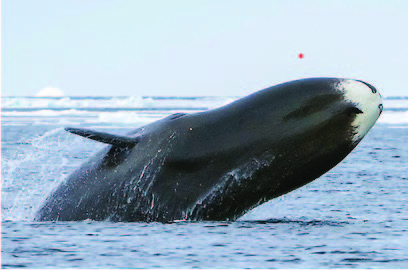
Bowhead whale, Balaena mysticetus, breaching among ice floe edge, Baffin Island, Nunavut, Canada, Arctic Ocean.
Photo Source: Blue Planet Archive / Doc White
The research suggests that bowhead whales have a super good way of fixing their DNA, which helps them live long without getting cancer. Scientists think the high levels of the CIRBP protein in the whales might be because of the extreme cold in the Arctic.
This research brings exciting possibilities for healthcare. By learning from bowhead whales’ DNA repair abilities, we might find new ways to heal tissues and fight cancer in humans. Understanding how these whales cope with extreme cold could also teach us about cryotherapy, a technique used in sports medicine for recovery. This could lead to longer, healthier lives for us.
– Bishal Thakur
Co-editor
Ankuram Academy (2023)


