The cheetah, scientifically known as Acinonyx jubatus, holds the title of the fastest land mammal, clocking speeds of up to 105 kilometers per hour on average, covering distances of hundreds of meters in its sprint.
Photo Source: Shutterstock
There is a discrepancy in the animal kingdom, indicating and inconsistency or unexpected difference among species or within ecosystems. While many key traits such as strength, limb length, lifespan and brain size tend to increase with animals’ size, maximum running speeds tend to be greatest in medium-sized animals. Maximum running speed tends to increase with animal mass, but only up to 50 kg (the average weight of cheetahs); beyond this, animals lose speed due to their size. Elephants, for instance, are relatively slow despite their long legs.
“Why does running speed break with the regular patterns that govern most other aspects of animal anatomy and performance?”
To explore why, an international team of researchers including Imperial, Harvard University, The University of Queensland and The University of the Sunshine Coast, developed a physical model of how muscles, the universal animal motor, set limits on land animals’ top running speeds. The results of the study were published in Nature Communications (Nat Commun 2024, 15, 2181). The study indicates that the maximum running speed is influenced by two factors: the speed and extent of muscle contraction. Animals, like cheetahs, of approximately 50 kg, find themselves in an optimal “sweet spot” where these factors align, enabling them to reach speeds of up to 105 km per hour (65 mph).
The study introduces two limits that determine the maximum running speed of animals: The first limit, known as the ‘kinetic energy capacity limit,’ proposes that the muscles of smaller animals are constrained by how rapidly they can contract. This limit is akin to running for a small animal being comparable to accelerating in a low gear when cycling downhill. Small animals generate significant forces relative to their weight, which affects their ability to sustain high speeds.
Conversely, the second limit, termed the ‘work capacity limit,’ suggests that the muscles of larger animals are restricted by how far they can contract. Larger animals, due to their heavier weight, produce less force in proportion to their size. Running for larger animals is likened to attempting to accelerate while cycling uphill in a high gear. Dr. Peter Bishop, a researcher at Harvard University, explains that for large animals like rhinos or elephants, running might feel like lifting an enormous weight due to their relatively weaker muscles and the increased gravitational demands.
The combined effects of these two limits mean that animals ultimately have to slow down as they increase in size.
To test the accuracy of their model, the researchers compared its predictions to data on land animal speed and size collected from more than 400 species, from large mammals, birds and lizards to tiny spiders and insects. The model accurately predicted how maximum running speeds vary with body size for animals that differ by more than 10 orders of magnitude in body mass – from tiny 0.1 milligram mites to six-tonne elephants.
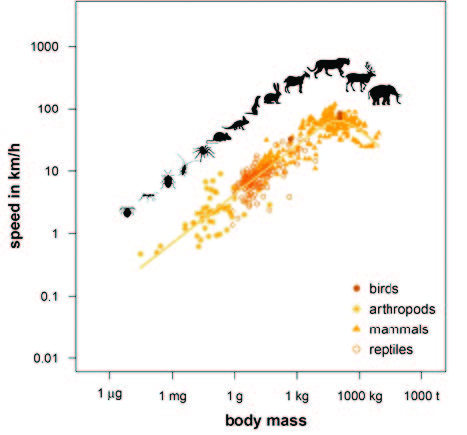
A correlation resembling a parabola exists between the body mass of animals and their maximum achievable speed. For the first time, researchers have succeeded in explaining this relationship using a basic mathematical model.
Photo Source: Myriam Hirt
Although the investigation focused solely on terrestrial animals, the researchers will next apply their methods to animals that fly and swim.
– Dinesh Ghimire HoD,
Faculty of Zoology
Ankuram Academy