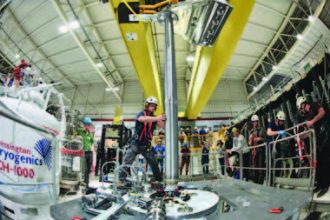
Example of an experimental setup. When laser light is transmitted through a gas, ultraviolet overtones arise from the atoms in the gas. In the right conditions, these overtones may be in phase. When their cycles coincide, concentrated attosecond pulses are formed.
Photo Source: John Jarnestad/the Royal Swedish Academy of Science
The 2023 Nobel Prize in Physics was granted to Pierre Agostini, Ferenc Krausz, and Anne L’Huillier for their innovative experimental techniques that produce attosecond (10-18 sec.) light pulses, enabling the study of electron dynamics within matter. The Royal Swedish Academy of Sciences announced this recognition on October 3, 2023. Their pioneering work provides humanity with novel tools to explore the behavior of electrons within atoms and molecules. Agostini, Krausz, and L’Huillier’s research allows for the creation of ultra-short light pulses, facilitating the observation and measurement of rapid electron processes, including movement and energy changes.
In 1987, Anne L’Huillier and her team made a breakthrough at a French laboratory by observing various light overtones while transmitting infrared laser light through noble gas. These overtones represent specific cycles of light waves generated by the interaction of laser light with gas atoms, providing the laser with additional energy to emit light. This discovery laid the foundation for future advancements.
In 2001, Pierre Agostini achieved a milestone by generating a series of consecutive light pulses lasting 250 attoseconds. Simultaneously, Ference Krausz conducted an experiment isolating a single light pulse for 650 attoseconds.
During the Nobel Prize ceremony, Eva Olsson, the chair of the Nobel Committee for Physics, highlighted the significance of these achievements, emphasizing their potential to unlock the realm of electrons. Attosecond technology not only offers insight into electron-driven mechanisms but also opens avenues for their practical utilization in future endeavors.
The laureates were honored for their techniques in creating attosecond light pulses. Attoseconds, a unit of time, make a blink of an eye seem eternal, like seconds compared to the age of the universe. These incredibly brief pulses enable scientists to study electron behavior in atoms and molecules with remarkable accuracy. By cleverly combining waves of various sizes, wavelengths, and amplitudes, any waveform can be constructed, allowing for the creation of shorter pulses through the use of multiple shorter wavelengths. The laureates devised innovative methods to generate attosecond pulses by directing intense laser light onto gas or solid targets, exploiting high harmonic generation to produce ultrashort pulses that act as rapid “camera flashes,” capturing electron motion in fundamental processes.
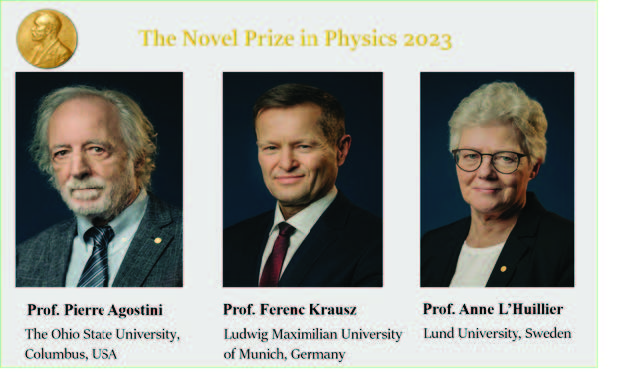
Photo Source: Clément Morin
Pierre Agostini’s team in France achieved a breakthrough by creating a series of consecutive light pulses, akin to a train with carriages, using a technique that synchronized the pulses with a delayed part of the original laser pulse, revealing their duration to be just 250 attoseconds. Meanwhile, Ferenc Krausz’s group in Austria developed a method to isolate individual pulses, lasting 650 attoseconds, to track electron processes.
These experiments validated the observation, measurement, and utility of attosecond pulses in new experiments. With the attosecond realm now accessible, these brief bursts of light offer unprecedented insight into electron movements, with technology advancing to produce pulses lasting just a few dozen attoseconds.
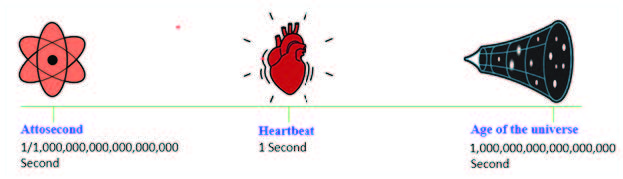
Electrons’ movements in atoms and molecules are so rapid that they are measured in attoseconds. An attosecond is to one second as one second is to the age of the universe.
Photo Source: John Jarnestad/the Royal Swedish Academy of Science
Attosecond science revolutionizes our understanding across various disciplines: unveiling the quantum behavior of electrons, tracking electron movement in materials science, deciphering chemical reactions, and aiding in understanding biological processes. These ultrafast pulses not only illuminate academic realms but also hold practical applications, from accelerating computer chip design to unraveling complex chemical reactions. Just as a conductor directs an orchestra, attosecond science empowers us to manipulate electrons, opening doors to quantum computing, ultrafast electronics and precision medicine advancements.
-Er. Tej Pd. Aryal
HoD, Computer Science
Ankuram Academy